Device data is difficult to use
Readings arrive in different formats, protocols or locations and people still need manual work to turn them into something operational.
IoT development services
Galvia builds the application, data and cloud layers around connected products and operational IoT systems. We help teams move from device data to dependable workflows, dashboards, mobile applications and integrations.
IoT software development from a Belfast engineering team working across connected devices, mobile, cloud and data.
Real-world data from connected assets.
Move data securely and reliably.
Turn device activity into useful software.
Turn information into action.
From connected hardware to a dependable application layer, the value appears when device data reaches the people and systems that can act on it.
Some of our clients


When to bring us in
The value of an IoT system normally appears after the device starts producing data. That is where applications, cloud platforms, APIs, reporting and operational workflows become important.
Readings arrive in different formats, protocols or locations and people still need manual work to turn them into something operational.
Connected hardware needs a mobile app, web interface, SDK or supported API so customers and internal teams can work with it reliably.
The first device-to-cloud path works, but monitoring, user access, data quality, failure handling and long-term ownership still need to be designed.
How we start
We start with what the hardware produces, how it communicates and what a person or another system actually needs to do with the information. That keeps the software architecture tied to a real use case.
.png)
Clarify hardware, connectivity, update frequency, offline behaviour, data formats, existing APIs and who owns each part of the system.
Agree the monitoring, alerts, application behaviour, integrations or reporting the users need rather than starting with a technology stack.
Prove the path from device to application, then add the testing, observability, security, documentation and handover needed for real operation.
Galvia is not positioning itself as a device manufacturer. Our strongest role is typically the software, application, cloud and data layer around connected hardware.
Published IoT and integration work
These public projects show Galvia working from hardware and device data through to applications, cloud platforms and the people who need to use them.
Galvia connected monitoring devices, normalised readings from different sources and delivered the information through a shared cloud platform for engineers and clients.
Read the McFarland case study ↗Galvia developed a cross-platform mobile SDK, demonstration application and supporting documentation to simplify hardware integration across Android and iOS.
Read the Stimare case study ↗Much of Galvia's industrial IoT experience is confidential. Public examples are used here only where the work can be described openly.
The people behind the work
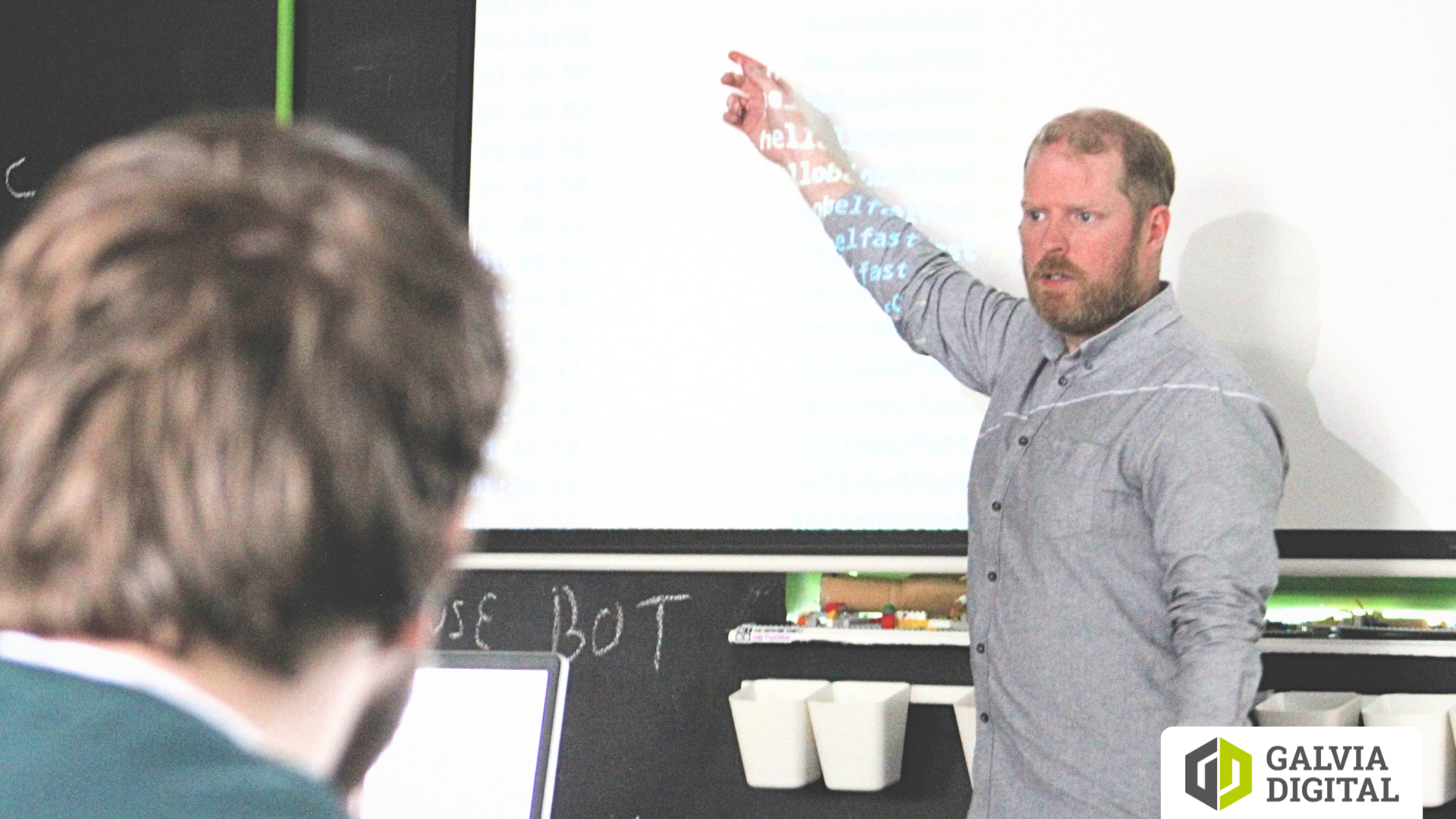
Galvia works across connected applications, cloud platforms, data, APIs and existing business systems. Martin Naughton is also a leading organiser of IoTBelfast, a community focused on practical connected technology and adjacent engineering topics.
Read about IoTBelfast ↗What the work can involve
Galvia can work on a bounded part of the architecture or help deliver the path from device data to an application or operational workflow.
Connect devices, gateways or existing platforms to the applications that need the information. Related work may use our custom API integration services.
Create or extend supported interfaces for customers, partners or internal applications. See API development services.
Ingest, structure and expose operational data for monitoring, analysis and reporting. See cloud migration and data analytics consulting.
Build the user-facing layer around connected hardware, including dashboards, mobile workflows, SDKs and applications that integrate with existing platforms.
The architecture should match the operating reality. Connectivity, offline behaviour, update frequency, device ownership, security and support all affect the right technical route.
FREE RESOURCE
IoT Project Planning Brief
Use the six-page IoT planning brief to capture the use case, hardware and interfaces, connectivity, data path, security boundaries, application requirements, integrations and the route from proof of concept to production.
Enter your details and go straight to the PDF. Marketing emails are optional.
Before you enquire
Depending on the project, work can include device connectivity, data ingestion, APIs, cloud services, web or mobile applications, dashboards, alerts, integrations, testing and operational handover.
Galvia's clearest strength is the software, application, cloud and data layer around devices. We can work with existing hardware, device suppliers and specialist partners where the responsibilities are clear.
Yes. We first establish what interfaces, protocols and access already exist, then decide whether to extend the current architecture or introduce a new software layer.
Yes. Galvia's published Stimare work includes a shared mobile SDK and demo application for barcode-scanner integration across Android and iOS.
Potentially. Existing applications can often remain part of the architecture if there is a safe interface or integration route. Where the older system itself is the constraint, legacy modernisation may need to be considered.
Yes. A bounded end-to-end proof can be useful when the main uncertainty is device communication, connectivity, data flow or user value. The success criteria and route beyond the PoC should be clear before it starts.
Tell us what needs to connect
Tell us what hardware or platform is involved, what data needs to move and what users or other systems need to do with it. We review each enquiry before arranging a call.
Commercial conversations are led by Martin Naughton, Galvia's founder and solution architect. Meet Martin.
Prefer email? info@galviadigital.com
Galvia Digital · Software for connected products and operations.